Against a person or against the machine. For a rating or for the pleasure of it.
With a coach at your shoulder or with nobody watching at all.
Game modes
Pick the game you are actually in the mood for
Rated
Online, rated
A real opponent and a real result. Every move is a transaction and the
contract referees the whole game, so the rating it writes at the end is not
an opinion.
Moves your Players rating. Analysis aids are
switched off while the game is live.
Casual
Online, casual
The same online game with nothing on the line. Keep the evaluation bar and
the best-move arrow switched on and treat it as a training game.
No rating change either way.
Rated
Computer, Normal
Ten opponents across nine engine levels, no hand-holding. The contract plays
the machine's side move by move, so it referees a computer game exactly the
way it referees a game against a person.
Moves your Bots rating. Both sides of the result are
written on chain.
Rated
Quick match
Pick a clock, press one button, and the seek pool pairs you with someone of
roughly your strength. The band widens while you wait, and if nobody turns
up it offers you the Challengers closest to your rating instead.
No empty lobby, no waiting on a stranger to notice you.
Rated
Puzzles
Tactics with the contract holding the answer. It hands out the position,
checks the line you play, and settles the result, which makes a tactics
rating that means something. There is an offline mode for pure practice.
Moves your Puzzles rating in Normal mode.
Practice
Computer, Learner
Move without hints, then get a straight answer about the move you played and
the one the coach wanted. The machine waits until you have decided which to
keep. Win a level and you win its badge.
Never affects any rating.
Practice
Computer, Offline
A quiet game that touches nothing. No network, no coaching, no rating, no
record beyond your own device. For the aeroplane and the waiting room.
Never affects any rating.
Two players
Pass & play
One device, two people, one board between you. The game is saved to your
history afterwards with the winning side recorded.
No rating change.
Variant
Chess960
All nine hundred and sixty back-rank arrangements, properly generated and
properly played. Opening theory will not save you here.
Available online and against the computer.
Study
Analysis board
Set a position up, take moves back, push them forward, and let the engine
argue with you. Any finished game turns into one with a single tap.
All aids available.
Why a computer game can count
A rating is only worth having if it cannot be typed in. Your browser can be
opened, read and edited by whoever is holding the device, so the browser is
never allowed to decide a result. It only ever authors your own moves.
That is straightforward in a game against a person: the contract sees every
move from both sides. Against the computer it works because the contract
plays the machine's side itself, using the same deterministic search
the app uses, seeded from chain data. Any node can replay the game and get the
same reply, which is what makes the number defensible.
So Normal mode against a Challenger is rated, and it settles on chain the
moment the game ends, however it ends: mate, resignation, timeout or draw.
Learner and Offline are deliberately never rated, because in those modes you
are allowed to take a move back.
The ladder
Ten opponents. Nine levels. One of them is a monk.
These are people, not notches on a difficulty slider. Each one is pinned to an
engine level from 1 to 9, and each carries its own rating, which is why two of
them share level 5 at different numbers: One-Eyed Pete throws everything at your
king, Master Kaito refuses to be provoked, and they are exactly as strong as each
other. More Challengers are on the way, and they will slot into the same nine
levels.
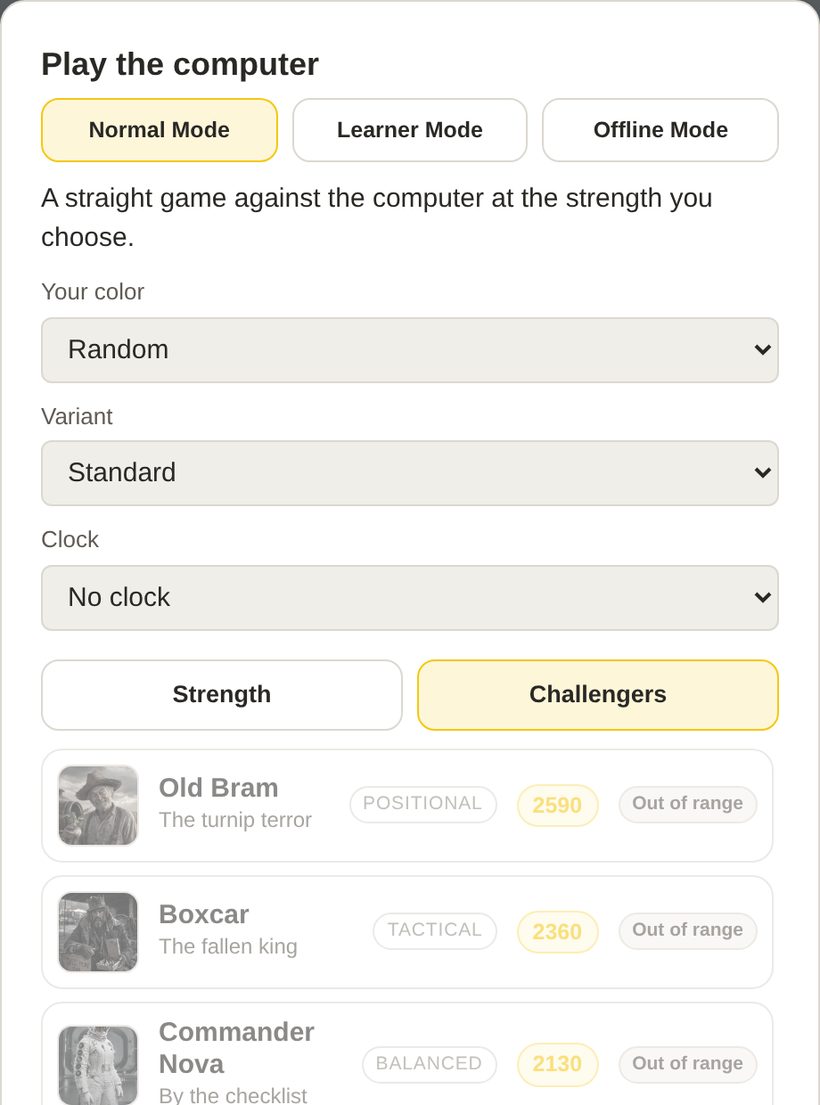
Picking an opponent. Each Challenger shows its temperament and its rating, with the ones near your own marked. Opponents far above you are held back until you have climbed to them.
Why some opponents are out of range
You cannot walk straight up to the hardest thing in the app and farm a rating
off it, and you cannot pad your number against the weakest either. The
contract enforces a band around your Bots rating, so a rated game is always
against something close enough to be a real test.
The Strength tab is still there if you would rather pick a level from 1 to 9
and ignore the personalities entirely.
L92590
Old BramThe turnip terror
Level 9 engine / Positional / rated 2590
Bram has farmed the same field for sixty years and played chess on an upturned barrel the whole time. He cannot name a single opening and he will still squeeze your position flatter than a pressed flower. Every move looks like a happy accident. None of them are.
L82360
BoxcarThe fallen king
Level 8 engine / Tactical / rated 2360
Nobody knows Boxcar's real name, or why a man who plays like a former champion lives out of a shopping cart, and he is not saying. He settles on a milk crate and produces moves of unsettling brilliance between bites of your lunch.
L72130
Commander NovaBy the checklist
Level 7 engine / Balanced / rated 2130
Nova does not get excited, tilt, or make interesting moves. Every decision runs through a mental pre-flight checklist. She will not dazzle you. She will quietly strap your position into a seat and lower it into the sun.
L61880
Nana BeatrixSweet until she isn't
Level 6 engine / Tactical / rated 1880
Nana pours the tea, asks after your mother, insists you take another cookie, then forks your king and queen without changing her expression. Fifty years in the church-basement club left her a nasty tactical eye and no mercy at all. The cookies are a trap.
L51610
One-Eyed PeteSac first, ask later
Level 5 engine / Wild / rated 1610
Pete holds that every piece is expendable and defence is for cowards. He hurls knights and bishops at your king like cannonballs and either mates you by move 20 or scuttles his own ship trying. There is no third setting.
L51540
Master KaitoThe wall
Level 5 engine / Defensive / rated 1540
Kaito is in no hurry. He will not attack you, dazzle you, or make a single move anyone would call fun. He builds a wall, absorbs everything, and waits for the endgame. Attacking him is like punching fog: exhausting, pointless, and somehow you end up on the floor.
L41420
Everyday JoStraight out of the textbook
Level 4 engine / Balanced / rated 1420
Jo is the opponent you learned on and never quite outgrew. She develops her pieces, castles on time and holds the centre. No tricks, no tantrums. Beating her feels earned, because it is.
L31180
Deb from AccountingEverything balances
Level 3 engine / Drawish / rated 1180
Deb does not take risks. Deb reconciles. She will trade the board down to a spotless symmetrical endgame and offer a draw with the enthusiasm of someone confirming a calendar invite. She simply declines to lose until boredom makes you do something silly.
L2980
Regular DaveYour uncle at Thanksgiving
Level 2 engine / Balanced / rated 980
Dave learned chess at a barbecue in 2004 and has felt unbeatable ever since, a confidence entirely unsupported by the evidence. He trades to keep it simple, walks into the same trap cheerfully, and will absolutely tell you he let you win.
L1820
Professor PonderAnalysis paralysis
Level 1 engine / Passive / rated 820
The Professor has read every chess book ever printed and recalls precisely none of them when it counts. He will deliver a ten-minute lecture on the Sicilian and then hang his queen on move six. Never beaten a computer before? Start here.
The clock
Time that both players can see the same way
Clocks are not run by your device and they are not run by ours. Each is
projected from the chain's own record of when the last move landed, so
there is nothing to argue about and no advantage in having the faster laptop.
Set the game up the way you like it, fast or slow, with an increment or without,
when you create it in the lobby or when you press Quick match.
Bullet is where the architecture shows. A one-minute game needs a move to be
final almost as soon as you let go of the piece, and the cluster settles a
block in about a hundred milliseconds. Your move is validated, applied and
recorded inside that window, and your opponent is pushed the new position off
the back of the same block. No queue, no batching, no waiting for a
confirmation depth.
The whole app is served by the nodes too. ITZA Chess is not a website
somewhere with a chain attached at the side: the pages, the engine and the
board all come off the same cluster that referees the game. There is no game
server in the middle to fall over, get slow, or quietly decide something on
your behalf.
1 + 0
Bullet
3 + 2
Blitz, the default
5 + 0 and 5 + 2
Blitz
10 + 5 and 15 + 10
Rapid
30 + 0
Classical
No clock
Take as long as you like
1 + 0
Bullet
3 + 2
Blitz, the default
5 + 0 and 5 + 2
Blitz
10 + 5 and 15 + 10
Rapid
30 + 0
Classical
No clock
Take as long as you like
1 + 0
Bullet
3 + 2
Blitz, the default
5 + 0 and 5 + 2
Blitz
10 + 5 and 15 + 10
Rapid
30 + 0
Classical
No clock
Take as long as you like
Increment is added by the contract, not by the client.
A fifteen-second grace after the flag falls, so a dropped connection is
survivable.
A win on time has to be claimed, and only the player being kept waiting can
claim it.
What makes a rated game rated
The contract validated every move from both players.
Move times come from the chain's block record, not from either
device.
The evaluation bar and best-move arrow are switched off for the duration.
The result is computed and written by the contract.
The rating change is applied to your account by the same contract, with no
way for a client to ask for a different number.