The Italian Game
The oldest opening anyone wrote down. Pieces out fast, bishop pointed straight at the weakest square in Black's camp.
Learn
Thirteen guided lessons, a teaching layer that colours every move you could make, and a learner mode that stops the clock to talk about the move you just played.
Guided lessons
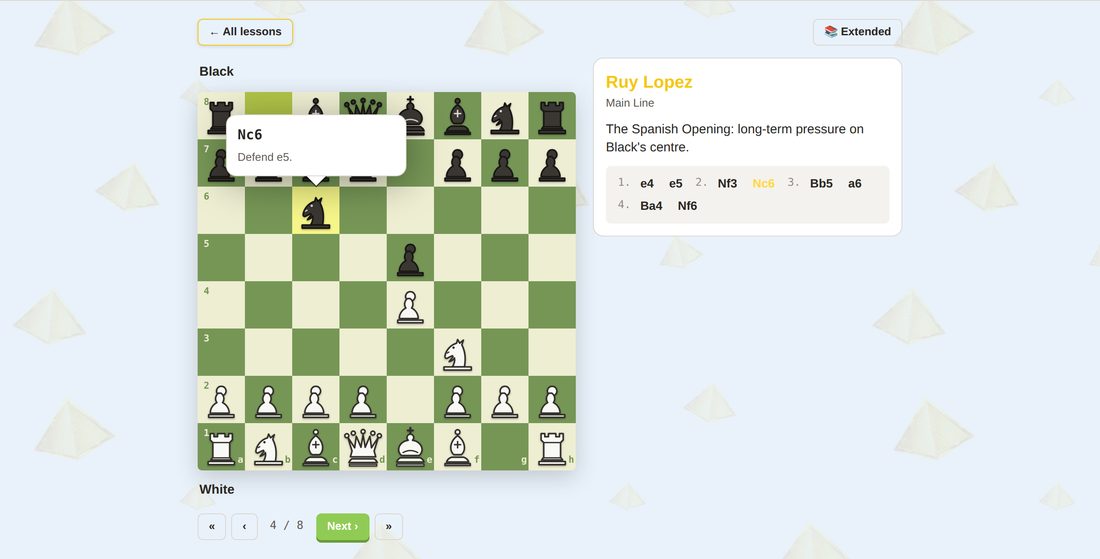
Pick a lesson and step the line one move at a time. Each move's idea appears on a card floating beside the board. Turn on Extended and the card grows into the full explanation, plus the story of where the opening or the pattern came from.
Every line is validated against the engine, so the moves are legal and the five mating lessons genuinely end in mate.
The oldest opening anyone wrote down. Pieces out fast, bishop pointed straight at the weakest square in Black's camp.
Attack the knight that holds the centre together. Four hundred years of theory and still the main line at the top.
Black refuses the symmetrical game and fights for the centre from the side. Sharp, unbalanced, and the most popular answer to 1.e4 there is.
Solid, stubborn, and built on a locked centre - along with the famous problem of what to do with the light-squared bishop.
Offer a wing pawn to pull the defender off the centre. Not really a gambit at all, which is part of the lesson.
One set-up you can play against almost anything. Easy to learn, hard to break, and quietly poisonous if you underestimate it.
Let White build the big centre, then knock it down with pieces and a pawn storm. The most aggressive way to answer 1.d4.
Every lesson has a second layer: who played it first, who made it famous, and what people believed about it before they knew better.
The king that castled to safety and never made a window. The first mate every player loses to, and then wins with forever.
The four-move attack on f7 - how to play it once, and how to stop it for the rest of your life.
A knight mating a king that is boxed in by its own pieces, set up by giving away the queen. The prettiest thing in chess.
A knight on e7, a rook down the h-file, and a king with nowhere left to stand.
The queen sacrifice that answers a pin with three minor pieces and a mate. Older than most countries.
Bishop takes h7, check. Knight follows, queen arrives. Learn when it works and, more usefully, when it does not.
Teaching mode
Switch it on in a game against the computer and every legal destination square gets a dot, from red through amber to green. Tap a square instead of moving to it and the coach explains itself.
Tapping a square opens a small card that floats next to it - above or below depending on where there is room - with the move's name, a one-word verdict, and a plain-English reason. If you agree with it, there is a Play button right there.
Scoring combines a shallow search of your opponent's best replies - which is what catches hanging pieces and short tactics - with positional judgement about the centre, development, castling and space.
Switch model and the colours change with it, because a move that serves one plan often works against another.
Teaching mode is available in games against the computer. It is hidden in learner games on purpose - and it does not appear in pass & play or in rated online games at all.
Learner mode
Hints before the move tell you what to do. Learner mode tells you what you did. It is a slower way to play and a much faster way to improve.
No colours, no arrows, no coaching. Just you and the position, exactly as it will be when it counts.
The square you played and the square the coach wanted, in the teaching colours. If they are the same square, you get one - and a nod.
An honest opinion of your move, with a Keep my move button. Tap the other square to hear why it was better.
The computer waits. Keep your move or take the recommendation - only then does the game carry on.
Learner mode starts at Level 1 and is always practice: it never changes any rating, so there is nothing to lose by taking your time over a move. Beat the level you are on and its badge is yours, with the confetti to match.
In the app
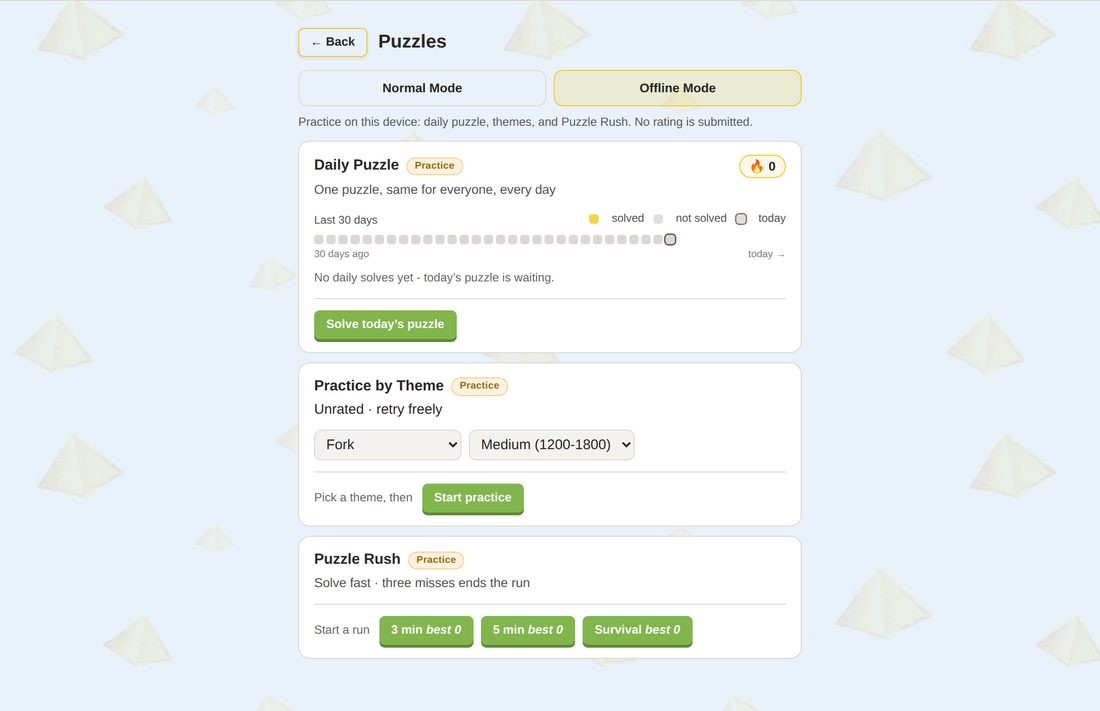
The shelf
A shelf of nine shields sits under the board in learner mode. Unearned ones show a teaser rather than the artwork, so there is still something to find out.
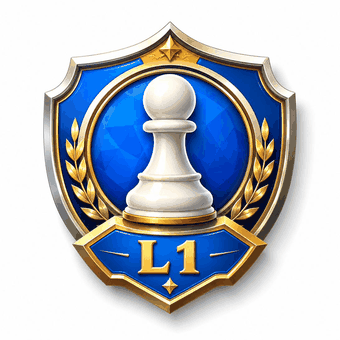
A white pawn on royal blue. The first one, and the one everybody remembers winning.
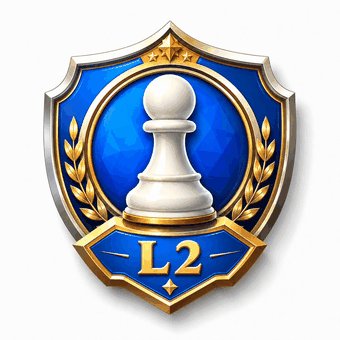
The pawn again, with stars above it. Proof the first one was not an accident.
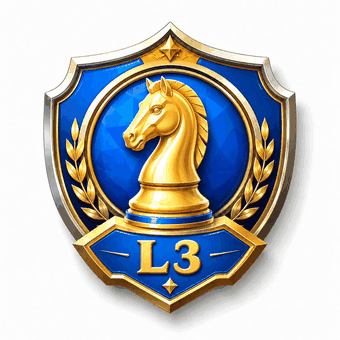
The knight, in gold. Where the pieces start to move like pieces.
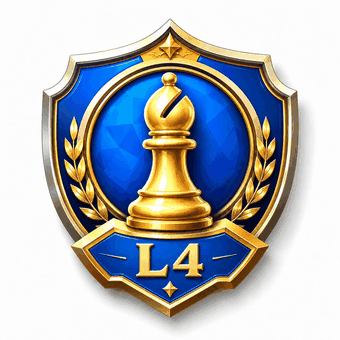
The bishop. Won by somebody who has stopped trading pieces at random.
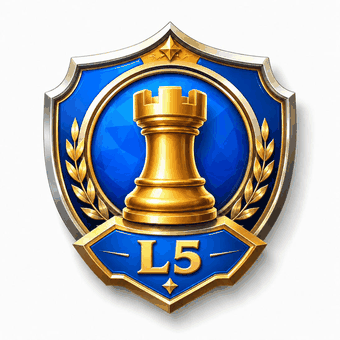
The rook. The halfway shield, and the first genuinely hard one.
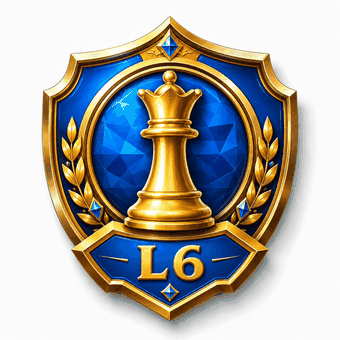
The queen, set with sapphires. Earned by keeping your head in a storm.
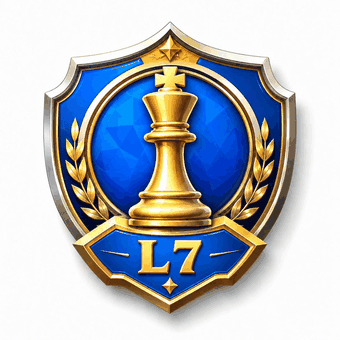
The king. At this level the tactics stop being optional.
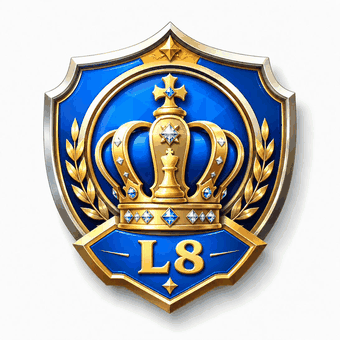
A jewelled crown over the king. Very few shelves have this one on them.
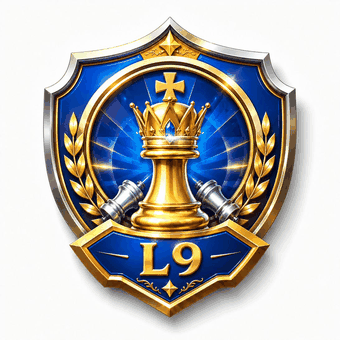
The crowned queen in full light, with two fallen kings beside her. The last shield there is.

This is what a badge you have not won looks like on the shelf - the shield, and nothing in it. Tap one and you get a hint about the level rather than the picture. The nine above are shown here because this is a website; in the app you have to go and get them.
After the game
The moment a game ends, every move has been graded - brilliant, great, good, inaccuracy, mistake, blunder - and both players have an accuracy score. The move you should have played sits next to the one you did.
Click any move to jump to that position. When you find the moment it went wrong, turn the game into an analysis board and play it out properly this time.
It works on every finished game, whoever you played: the computer, a person online, or the person sitting opposite you.
Seven openings, six mating patterns, every line checked by the same engine that referees the games.